LEGAL MEMORANDUM
FROM: Ankit Khetarpal, Attorney at Law / Barrister & Solicitor (ASM Legal Professional Corporation)
DATE: September 14, 2026
SUBJECT: Canadian E-2 Treaty Investors Operating Commercial Motor Vehicles in the United States: Canadian CDL Reciprocity, U.S. Domicile Requirements, Non-Domiciled CDL Rules, Cabotage Considerations, and Permissibility of Incidental Truck Driving by an E-2 Principal Investor
I. QUESTION PRESENTED
Whether a Canadian citizen who:
- Holds a valid Canadian provincial commercial driver's licence (CDL) appropriate for the commercial motor vehicle (CMV) being operated;
- Has been admitted to the United States in valid E-2 Treaty Investor status pursuant to Immigration and Nationality Act (INA) § 101(a)(15)(E)(ii), 8 U.S.C. § 1101(a)(15)(E)(ii);
- Owns and operates a U.S. trucking or transportation enterprise;
- Primarily develops, directs, manages, and protects that enterprise; and
- From time to time personally operates one or more commercial motor vehicles belonging to the enterprise,
may lawfully operate those vehicles in the United States without obtaining a U.S. non-domiciled CDL, and whether such incidental driving is compatible with the individual's E-2 Treaty Investor classification.
II. SHORT ANSWER
Yes, subject to important factual and legal qualifications.
Federal commercial-driver licensing law expressly recognizes qualifying Canadian provincial and territorial commercial driver's licences under 49 C.F.R. § 383.23(a)(2) and long-standing international reciprocity agreements (Statement of Reciprocity, 53 Fed. Reg. 18049; 57 Fed. Reg. 31454). The Federal Motor Carrier Safety Administration (FMCSA) recognizes an appropriate Canadian commercial licence as the sole commercial driver's licence for U.S. operations. Under the single-license mandate of 49 C.F.R. § 383.23(b) and 49 C.F.R. § 383.5, a qualifying Canadian commercial driver generally is ineligible for—and prohibited from obtaining—a separate U.S. non-domiciled CDL.
This commercial licensing conclusion is independent of the immigration analysis. An E-2 Treaty Investor is admitted to the United States to "solely... develop and direct the operations of an enterprise" (INA § 101(a)(15)(E)(ii); 8 C.F.R. § 214.2(e)(16)). Neither the statute, the governing regulations, nor Foreign Affairs Manual guidance (9 FAM 402.9-6(B)) categorically prohibit a principal investor from personally performing operational functions.
Controlling appellate precedent in Lauvik v. INS, 910 F.2d 658 (9th Cir. 1990), establishes that an investor may perform operational or skilled/unskilled labor where the investor's predominant role remains directing, managing, and protecting the investment. Preamble regulatory history to the E-2 regulations (62 Fed. Reg. 53250, 53252) explicitly affirms that an investor may engage in "hands-on" duties where those duties are purely incidental to developing and directing the enterprise.
Conversely, LawnsMade4U, LLC v. USCIS, 2021 WL 4483506 (N.D. Tex. 2021), and the E-2 marginality doctrine (9 FAM 402.9-6(E)) mark the outer boundary: where the investor becomes the primary laborer generating the entity's core revenues rather than its manager, E-2 status is compromised.
There is no bright-line numerical safe harbor (e.g., a 20% or 40% rule). The analysis is functional and fact-specific. Incidental driving by an investor-manager is legally supportable; full-time operational truck driving under the guise of an E-2 investment carries severe immigration risks.
III. THE TWO LEGAL QUESTIONS MUST REMAIN SEPARATE
This inquiry requires independent evaluation under two distinct bodies of federal law.
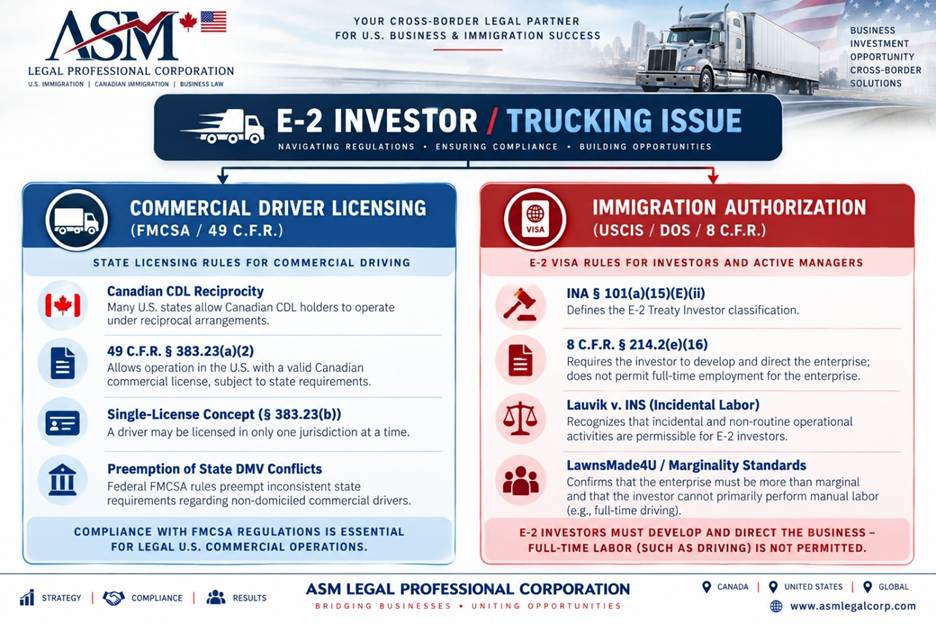
A. Commercial-Driver Licensing (FMCSA Domain)
Does the individual possess a commercial driver's licence recognized as authorizing operation of the particular CMV in the United States?
For qualifying Canadian drivers, federal statutory law (49 U.S.C. § 31136), regulations (49 C.F.R. Part 383), and administrative agreements resolve this through federal Canadian-U.S. CDL reciprocity.
B. Immigration Authorization (USCIS/DOS Domain)
Is the individual's performance of the particular activity consistent with their E-2 Treaty Investor status?
Possession of a valid commercial driving credential does not confer immigration work authorization. Conversely, valid E-2 status does not exempt an individual from motor-vehicle safety and licensing laws. Both regulatory regimes must be independently satisfied.
IV. CANADIAN COMMERCIAL DRIVER'S LICENCES ARE FEDERALLY RECOGNIZED
Under 49 C.F.R. § 383.23(a)(2), a driver holding a commercial driver's licence issued by a Canadian province or territory in accordance with the Canadian National Safety Code (NSC) standards is expressly recognized as qualified to operate a commercial motor vehicle in the United States.
A. Historical and Regulatory Basis
- Reciprocity Executive Mandate: On May 19, 1988, the U.S. Federal Highway Administration (FHWA) and Canadian provincial authorities executed a reciprocal agreement determining that Canadian testing and licensing standards mirror U.S. standards (See 53 Fed. Reg. 18049; expanded in final rule at 57 Fed. Reg. 31454, July 16, 1992).
- Single-License Rule: Pursuant to 49 C.F.R. § 383.23(b), commercial drivers in the U.S. are strictly limited to holding a single driver's licence.
- Ineligibility for Non-Domiciled CDL: Under 49 C.F.R. § 383.5, a "Non-Domiciled CDL" is reserved exclusively for drivers domiciled in foreign countries whose standard commercial licensing tests have not been determined to meet FMCSA standards. Because Canada's standards do meet U.S. standards, Canadian CDL holders are legally precluded from obtaining a state-issued non-domiciled CDL.
Consequently, foreign-licence recognition is not an exception or loophole; it is the primary statutory mechanism established by Congress and the Department of Transportation.
V. EMPLOYMENT BY A U.S. CARRIER DOES NOT ITSELF DETERMINE CDL JURISDICTION
FMCSA administrative guidance confirms that the corporate nationality or physical location of the motor carrier does not alter the driver's licensing jurisdiction.
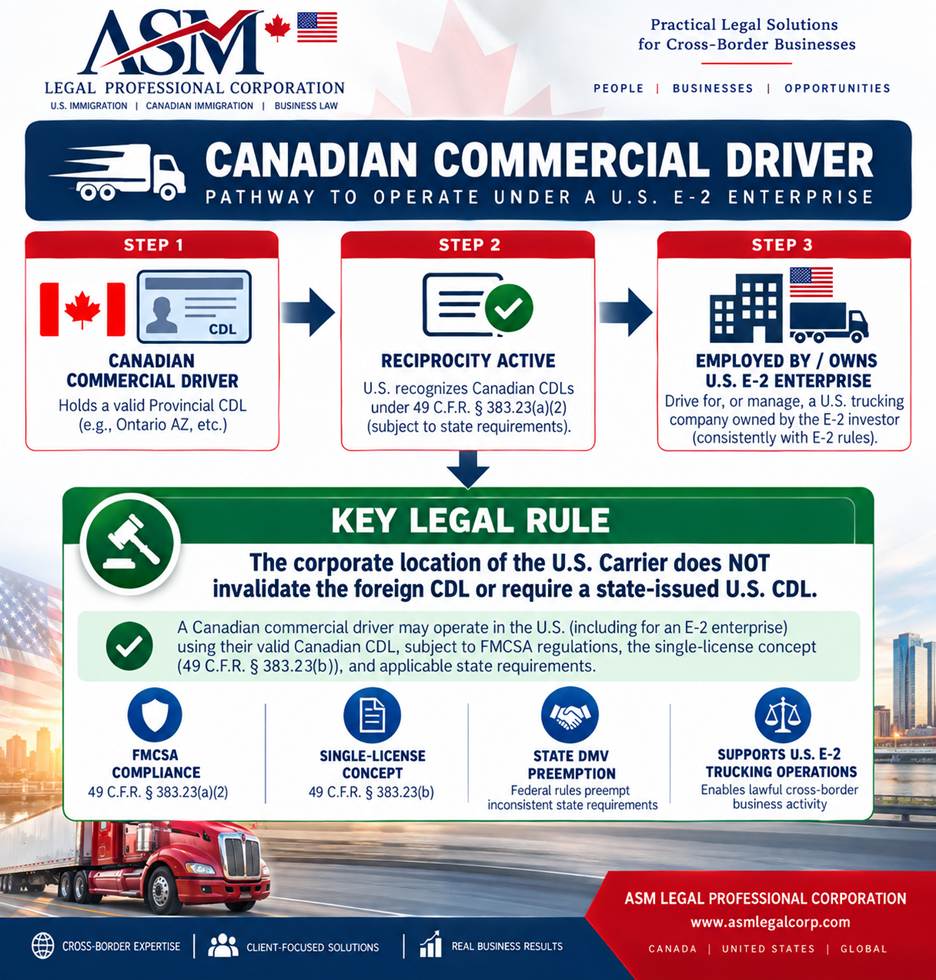
In official guidance interpreting CDL reciprocity with treaty partners (including parallel interpretations for Canadian and Mexican reciprocity frameworks), FMCSA established that a driver domiciled in a foreign country who operates for a U.S.-based entity is not required to obtain a state-issued CDL merely because the employer is an American entity (See FMCSA Regulatory Guidance, 49 C.F.R. § 383.23, Question 2).
VI. DOMICILE AND THE NON-DOMICILED CDL ISSUE
Federal CDL requirements hinge on legal "domicile" rather than temporary physical presence or non-immigrant residency.
- 49 C.F.R. § 383.5 Domicile Framework: State licensing agencies issue standard CDLs to individuals domiciled within their specific state boundaries.
- E-2 Non-Immigrant Intent: An E-2 investor resides in the United States pursuant to non-immigrant status (8 U.S.C. § 1101(a)(15)(E)), maintaining an intent to depart upon termination of status. Physical presence in a U.S. state while managing a business does not eliminate federal CDL preemption (49 U.S.C. § 31136).
- State DMV Preemption: While individual state codes (e.g., local state Departments of Motor Vehicles) require permanent residents to obtain local passenger driver's licenses within 30 to 90 days, state statutes requiring local commercial licensing are preempted by federal commercial safety laws (49 C.F.R. Part 383) when applied to qualifying Canadian commercial drivers.
VII. CALIFORNIA GUIDANCE AND ENFORCEMENT PRACTICE
California represents a primary jurisdiction for commercial enforcement analysis. The California Highway Patrol (CHP) enforces commercial operations under the CHP Commercial Enforcement Manual (HPM 82.2).
- CHP Manual Standards: HPM 82.2, Chapter 2 (Driver Licensing Requirements), explicitly incorporates federal Canadian reciprocity. CHP officers are instructed to honor valid Canadian provincial licenses (Classes 1, 2, 3, and A, B, C) as meeting California vehicle code requirements.
- Non-Domiciled Restrictions: California Department of Motor Vehicles (DMV) administrative policies restrict non-domiciled CDL issuance to individuals who cannot obtain a recognized home-country CDL. Because Canadian licenses are fully recognized, California DMV will not issue a California non-domiciled CDL to a Canadian provincial license holder.
VIII. STATE v. MORA — PERSUASIVE AUTHORITY ON FOREIGN CDL RECIPROCITY
The legal relationship between temporary U.S. residence, foreign commercial licenses, and federal reciprocity was analyzed in State v. Mora, 2020 WI App 30, 392 Wis. 2d 353, 944 N.W.2d 48 (Wis. Ct. App. 2020).
- Context: A foreign national residing temporarily in Wisconsin under federal work authorization operated commercial vehicles using a home-country commercial license recognized under federal reciprocity agreements.
- Holding: The appellate court held that physical residence within a U.S. state under temporary federal immigration authorization does not terminate the validity of a reciprocal foreign commercial driver's license, nor does it force the driver into state CDL non-compliance.
- Application: Mora confirms that federal international reciprocity structures preempt state-level arguments claiming that local physical residence invalidates foreign commercial driving credentials.
IX. THE SEPARATE E-2 IMMIGRATION QUESTION
Establishing
that an investor possesses a valid commercial driving credential under FMCSA
standards resolves only the transportation law issue. The separate immigration
inquiry is whether operating a commercial motor vehicle complies with E-2
status. 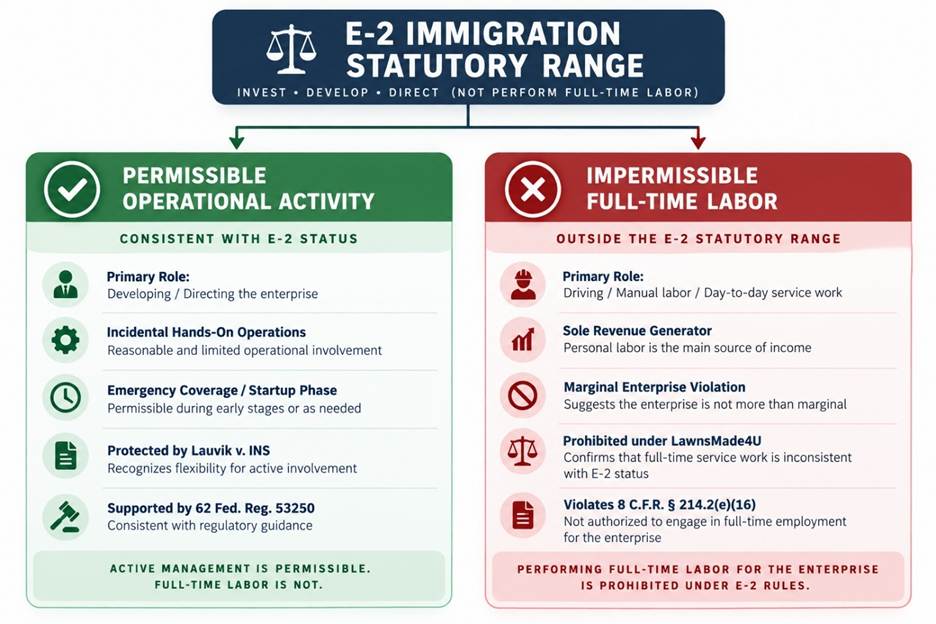
A. Statutory and Regulatory Mandates
- INA § 101(a)(15)(E)(ii): Mandates that the applicant is entering the U.S. "solely to develop and direct the operations of an enterprise in which he has invested."
- 8 C.F.R. § 214.2(e)(16): Defines "develop and direct," requiring the investor to demonstrate control over enterprise management and operational policy.
- 9 FAM 402.9-6(B): Department of State instructions clarify that the E-2 visa cannot serve as a vehicle for foreign nationals to engage in general skilled or unskilled labor in the U.S. labor market.
X. LAUVIK v. INS — PRINCIPAL AUTHORITY ON INCIDENTAL LABOR
The leading federal appellate decision addressing operational labor by a principal Treaty Investor is Lauvik v. INS, 910 F.2d 658 (9th Cir. 1990).
A. Background and INS Position
The foreign investor purchased a motel and trailer park enterprise in the State of Washington. Due to operational realities, the investor personally performed skilled and unskilled physical tasks, including repairing plumbing, managing grounds, handling check-ins, and cleaning units. INS sought to deport the investor, asserting that performing operational labor violated the requirement to "solely develop and direct" the enterprise.
B. Ninth Circuit Holding
The Ninth Circuit rejected INS's categorical stance, reversing the deportation order:
"The performance of non-qualifying tasks does not disqualify an alien from E-2 status if the alien primarily manages the enterprise... An investor who manages and directs an enterprise may perform some of the daily tasks of the business without losing E-2 status." — Lauvik v. INS, 910 F.2d at 661–62.
C. Principle Applied to Transportation
Lauvik establishes that performance of operational or physical duties does not invalidate E-2 status where those tasks remain subordinate to the investor's primary role of managing, directing, and protecting the enterprise.
XI. REGULATORY HISTORY EXPRESSLY PERMITS INCIDENTAL "HANDS ON" DUTIES
The regulatory history of the E-2 regulations explicitly affirms the Lauvik principle.
When legacy INS promulgated rewritten E-2 regulations, public commenters expressed concern that strict management requirements would penalize small-business owners who perform operational tasks. The Department officially responded in the Federal Register:
"The Service agrees that an investor may perform 'hands-on' duties as long as these duties are purely incidental to developing and directing the operations of the enterprise."
— 62 Fed. Reg. 53250, 53252 (Oct. 13, 1997) (Final Rule regarding E Nonimmigrant Classification).
This administrative preamble provides explicit regulatory authority confirming that operational engagement (including driving equipment) is permissible where it remains incidental to executive direction.
XII. LAWNSMADE4U AND THE MARGINALITY DOCTRINE (THE LEGAL LIMITATION)
The outer boundary of permissible operational labor is illustrated by LawnsMade4U, LLC v. USCIS, 2021 WL 4483506 (N.D. Tex. Sept. 29, 2021).
A. Facts and Record
An E-2 investor established a landscaping enterprise. Although original business plans proposed hiring employees, evidence showed that years later the investor remained the sole functional worker, performing physical landscaping labor 60% of his working time, with remaining time split between administrative tasks and marketing.
B. Judicial Ruling
The federal district court upheld USCIS's denial of status extension. The court held that where an investor serves as the principal laborer generating the entity's baseline revenue, the individual is no longer acting "solely to develop and direct" the enterprise, and the business violates the Marginality Doctrine (9 FAM 402.9-6(E); 8 C.F.R. § 214.2(e)(15)).
C. Analytical Comparison
|
Legal Dimension |
Lauvik v. INS (Permissible) |
LawnsMade4U v. USCIS (Impermissible) |
|
Primary Activity |
Strategic direction, asset management, capital outlay, expansion oversight. |
Daily execution of core physical services. |
|
Labor Distribution |
Operational labor is occasional, temporary, or supplemental. |
Operational labor constitutes over 50% of investor time. |
|
Workforce Structure |
Employs/contracts independent operational staff. |
Sole employee or primary worker. |
|
Revenue Source |
Enterprise capital assets and hired workforce. |
Derived directly from investor's personal manual labor. |
XIII. IMMIGRATION AUTHORIZATION VS. IMMIGRATION CABOTAGE RULES
A crucial legal distinction exists between B-1 Business Visitor Cabotage Restrictions and E-2 Treaty Investor Work Authorization:
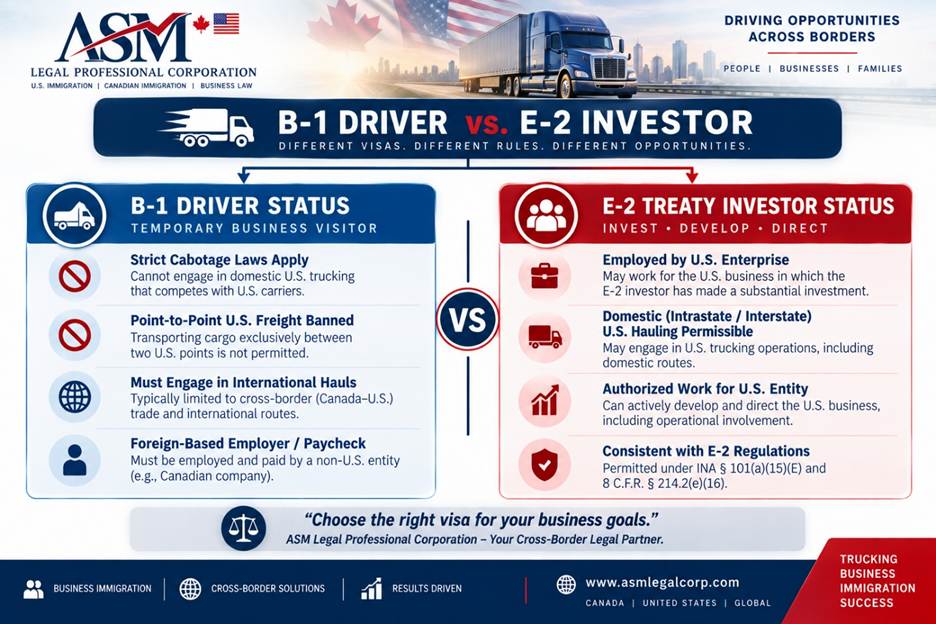
- B-1 Cabotage Prohibitions: Foreign commercial drivers operating under B-1 temporary visitor visas are restricted by U.S. Customs and Border Protection (CBP) cabotage rules (8 C.F.R. § 214.2(b)(4)). They cannot pick up freight at point A in the U.S. and deliver it to point B in the U.S.
- E-2 Authorization Scope: An E-2 investor in a U.S. enterprise is authorized to work for the U.S. business entity. Consequently, when an E-2 investor drives a vehicle owned by their U.S. enterprise, they are operating as an agent of a domestic U.S. carrier, which removes standard B-1 foreign cabotage limitations on internal U.S. routes.
XIV. ABSENCE OF A NUMERICAL SAFE HARBOR
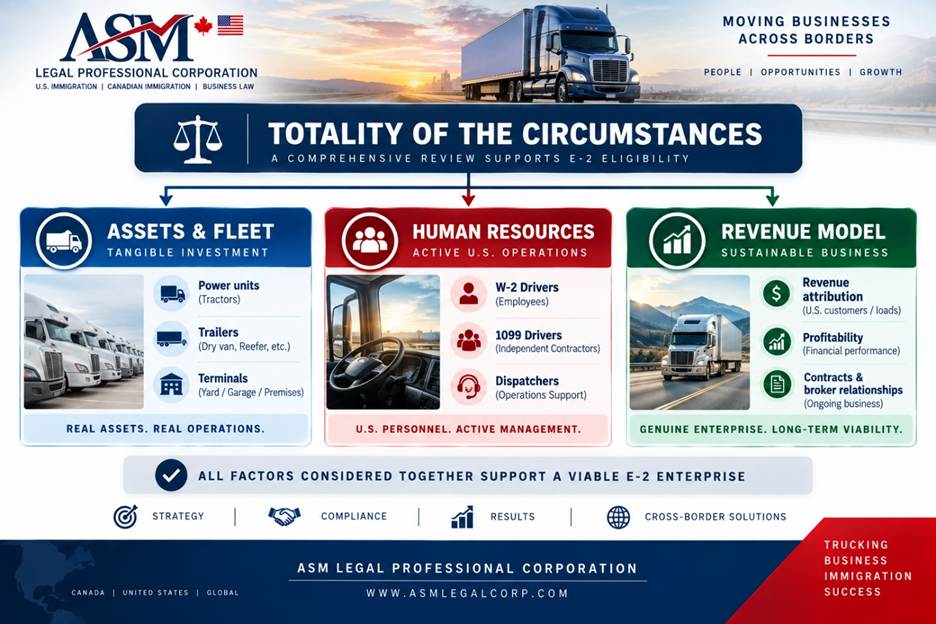
No statute, regulation, or reported precedent creates a mathematical percentage safe harbor (e.g., "driving 30% of the time is safe"). USCIS and DOS adjudicators apply a totality of the circumstances test evaluated against the following factors:
XV. START-UP OPERATIONS AND PROGRESSION OBLIGATIONS
During the initial phase of a business (typically Year 1), owner-investors routinely execute multiple tasks. Early operational driving is defensible under Lauvik during initial fleet assembly or driver recruitment.
However, as the enterprise matures, failure to transition operational driving duties to hired staff creates exposure under LawnsMade4U.
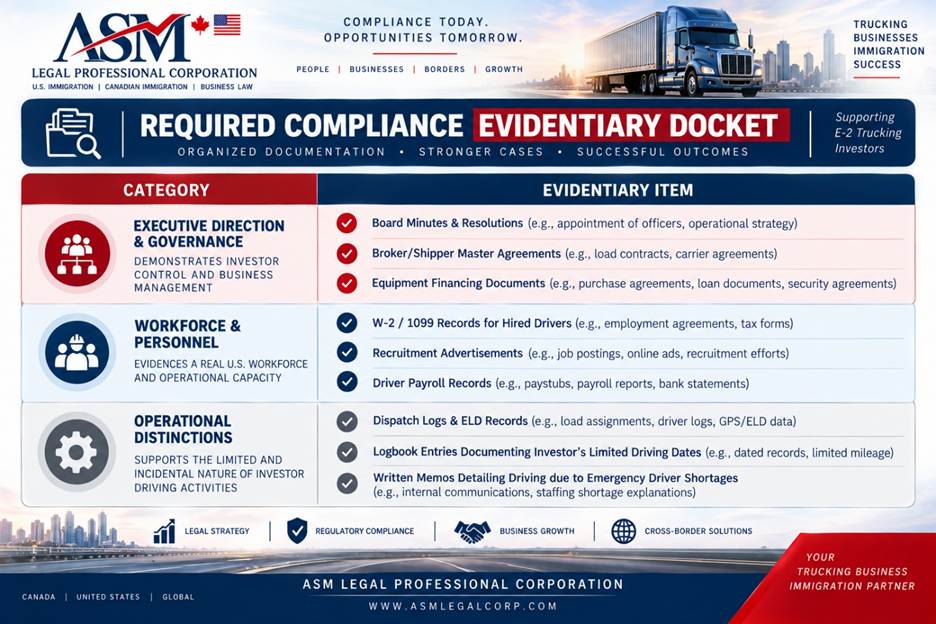
XVI. PRACTICAL DOCUMENTATION MATRIX FOR E-2 TRUCKING INVESTORS
To safeguard E-2 status against administrative challenge, the enterprise should maintain contemporaneous documentation establishing that driving activities remain incidental:
XVII. COMMERCIAL MOTOR VEHICLE LICENSING QUALIFICATIONS
Nothing in immigration law overrides basic driver qualification standards. The Canadian CDL must satisfy:
- Appropriate Class: Class 1 (or A) for tractor-trailers.
- Medical Certification: Compliance with Canadian Medical Standards under the NSC (honored via FMCSA reciprocity).
- Endorsements/Restrictions: Proper air-brake and hazardous material endorsements where applicable.
XVIII. MOTOR CARRIER OPERATING AUTHORITY IS SEPARATE
Driver licensing and immigration status do not confer carrier operating rights. The U.S. enterprise must maintain independent compliance under FMCSA and DOT regulations:
- USDOT Number & MC Authority (49 C.F.R. Part 365).
- Process Agent Filings (Form BOC-3).
- Unified Carrier Registration (UCR) and IFTA/IRP registration.
- Drug and Alcohol Clearinghouse compliance (49 C.F.R. Part 382).
XIX. INTERSTATE AND INTRASTATE COMMERCE DETERMINATIONS
Carriers must evaluate whether operations constitute interstate commerce. Freight moving strictly within one state may still constitute interstate commerce under federal law if the cargo originated out-of-state or is part of a continuous interstate movement (See 49 C.F.R. § 390.5). CDL reciprocity applies to both interstate and intrastate movements of interstate freight.
XX. SUMMARY LEGAL PROPOSITIONS
- Proposition One (CDL Reciprocity): A Canadian E-2 Treaty Investor holding a valid provincial CDL operates under valid U.S. commercial driving authority pursuant to 49 C.F.R. § 383.23(a)(2) and Federal Register reciprocity determinations.
- Proposition Two (U.S. Carrier Ownership): Operating vehicles owned by a U.S. enterprise does not invalidate a recognized foreign CDL or force issuance of a U.S. non-domiciled CDL (49 C.F.R. § 383.23(b)).
- Proposition Three (E-2 Permissibility): Performance of operational tasks by an investor is authorized under Lauvik v. INS and 62 Fed. Reg. 53250.
- Proposition Four (Incidental Requirement): Driving must remain subordinate to executive management, asset direction, and business growth.
- Proposition Five (Operational Risk): Full-time driving that serves as the principal source of company revenue creates severe risk under LawnsMade4U and marginality doctrines (9 FAM 402.9-6(E)).
XXI. RECOMMENDED COMPLIANCE OPERATIONAL MODEL
The defensible operating structure for an E-2 trucking investor requires:
- Corporate Governance: Active management of assets, capital, and insurance.
- Labor Structure: Hiring W-2 employees or contracting independent commercial drivers.
- Targeted Investor Driving: Personal driving reserved for equipment repositioning, driver training, customer emergencies, or unexpected driver absence.
XXII. OVERALL FORMAL LEGAL OPINION
It is our legal opinion that a Canadian citizen admitted to the United States as an E-2 Treaty Investor may lawfully operate commercial motor vehicles owned by their E-2 enterprise, provided that the driver holds a valid, unrestricted Canadian provincial commercial driver's licence appropriate for the vehicle class. Such driving is recognized under federal CDL reciprocity regulations (49 C.F.R. § 383.23).
From an immigration standpoint, operational truck driving by an E-2 principal investor is legally permissible under Ninth Circuit precedent (Lauvik v. INS) and official legacy INS regulatory preamble (62 Fed. Reg. 53250), provided that such driving remains purely incidental to the investor's primary duties of developing, directing, managing, and protecting the enterprise.
Driving commercially on a full-time, primary basis shifts the investor into the role of a standard laborer, violating 8 C.F.R. § 214.2(e)(16) and exposing the status to revocation under LawnsMade4U, LLC v. USCIS.
XXIII. LIMITATION OF OPINION
This legal memorandum is restricted to the intersection of federal commercial motor vehicle safety standards, federal CDL reciprocity, and E-2 non-immigrant immigration law. It does not constitute a blanket authorization for all commercial operations without individual case evaluation.
ASM LEGAL PROFESSIONAL CORPORATION
Ankit Khetarpal, Attorney at Law / Barrister & Solicitor
All Rights Reserved. Prepared for legal analysis and client advisory purposes.